
About Sustainable Living
 Each of the following lifestyle changes is an investment in a future with affordable fresh food for all and safety from extreme weather events, like dramatic heat waves and destructive flooding.
In addition to climate change, there are 8 other planetary boundaries that make human survival on planet earth possible. When we exceed these limits, we make it more difficult for the global population to thrive. (stockholmresilience.org and doughnuteconomics.org)
Our daily choices and long-term investments impact these boundaries in a variety of ways. For example, the popularity of some foods that we love, like chocolate, has increased deforestation. Burning fossil fuels (gasoline for cars, boats and planes, natural gas to heat our homes, etc.) increases CO2 in the atmosphere which destabilizes our weather systems, increasing extreme rains or heat, which make food harvests – including chocolate and olive oil – more precarious.
Resources to Learn More About What You Can Do to Take Action
- Project Drawdown: answer a quiz to get a Personalized Guide to Climate Action. Quite extensive. Very well-researched, with good explanations. drawdown.org/shift
- A nuanced understanding of individual action: “Conscious consumerism is a lie,” article by sustainable lifestyle blogger Alden Wicker https://qz.com/920561/conscious-consumerism-is-a-lie-heres-a-better-way-to-help-save-the-world
- Doughnut Economics: provides information on the 9 planetary boundaries, as well as social limits that society is facing. doughnuteconomics.org
Fun and Informative Activities to Learn More
- 2 Tonnes (in French or in English) www.2tonnes.org – learn about your impact
- 2030 Glorieuses (in French) www.2030glorieuses.org – imagine a positive sustainable future
- Climate Fresk (in French or in English) www.climatefresk.org – learn about global warming
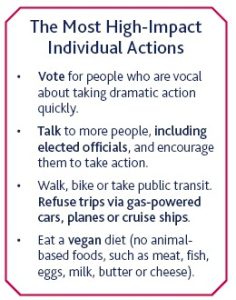
The Most High-Impact Individual Actions
Vote for people who are vocal about taking dramatic action quickly.
Talk to more people, including elected officials, and encourage them to take action.
Walk, bike or take public transit. Refuse trips via gas-powered cars, planes or cruise ships.
Eat a vegan diet (no animal-based foods, such as meat, fish, eggs, milk, butter or cheese).
Housing
- Install low-flow faucets on your water faucets and shower head.
- Turn off lights and appliances when not in use, or use timers to manage this for you.
- Switch from a gas stove to an induction stove or a regular electric stove. This is excellent for indoor air quality and improves your personal health.
- Switch to Enercoop for your electricity, which is the only French renewable energy supplier that is using revenue from customers to generate more renewable energy production sites.
- Homeowners: insulate your home to increase your own comfort and reduce your energy bills. The ceiling/roof, walls and floor can all be insulated. Windows and doors that are double paned and installed to reduce drafts are important. Be careful to avoid any cold spots (fr: “ponts thermiques”) to avoid condensation. Increased insulation requires a good ventilation system to avoid humidity issues, especially in the bathrooms and kitchen.
- Homeowners: consider a PAC (heat pump) for heating/cooling your home after it is well-insulated, or replace your gas furnace with a wood or pellet boiler for your radiators.
Food & Grocery Shopping
- Eat a local and plant-based diet, and eliminate or significantly reduce your consumption of animal products, especially meat, cheese and dairy products. This is a heart-healthy option!
- Buy foods that are organic, locally produced and in-season. Use the Fork Ranger app for help with this. Opt for restaurants that prioritize local and in-season meals.
- Save and eat your leftovers, even small amounts. Eat foods before their expiration date.
- Compost your food waste with the city’s system. Worm-bins make your waste disappear!
- Buy ugly fruits and vegetables. Rescue foods that would otherwise go to waste.
- Bring your own bags, and reuse old bags. Manufacturing new organic cotton bags is worse than the environmental impact of the whole life-cycle of a plastic bag.
- Say no to single-use plastic, including plastic bags, cutlery and “paper” cups (which are all plastic-lined). Bring your own reusable bamboo cutlery and napkin for eating on the go.
Home & Garden
- Repair clothes, appliances, electronics and other items to use them as long as possible. Find a Repair Café where volunteers help you fix the things you own: www.repaircafe.org.
- Invest in items that you will keep for 10-30+ years, and stop purchasing items you may only enjoy for a short period of time. Invest in experiences instead of things.
- Buy second-hand or refurbished electronics, clothes, appliances, kids’ games, furniture, and other household goods. Try LeBonCoin.fr, Emmaüs, “recycleries”, Selency.fr, or Vinted.fr.
- Delete old messages, documents, photos and emails from your electronic devices.
- Avoid using AI, because of the very high energy use required to run these programs.
- Refill your dry goods by buying at bulk (fr: “vrac”) stores (like Day-by-Day, Naturalia or Biocoop). Or buy in consigned glass from stores like Le Fourgon (use Jill’s code for a discount: JIAM4284).
- Hygiene: choose moon cups, washable pads, menstrual underwear, shampoo bars and bamboo toothbrushes. Choose sustainable makeup and personal care products from stores like Lamazuna or Altermundi.
- Learn where to dispose of items properly: https://quefairedemesdechets.ademe.fr. Avoid “wishful recycling”, which is when we make incorrect assumptions about what our local collection accepts. This clogs up recycling centers, costing time and public money.
- Have flower boxes, a balcony or a lawn? Plant native flowering plants that attract butterflies and other important insects needed for the ecosystem to run smoothly.
Transportation
- Moving by foot, bike and public transport are the most ecological transportation options.
- Avoid Uber and taxis, as they are the equivalent to driving a car. Carpool when possible.
- Car owners: drive your current car for as long as possible, making repairs for many years. Most of the environmental impact of a car occurs in the manufacturing process.
- Car buyers: opt for a small electric car (EV) with a good range (fr: “autonomie”). Ideally second-hand. Heavier electric cars (like Teslas) consume so much electricity, they aren’t ecologically better than cars that burn fossil fuels.
Vacationing
- Prioritize train travel, if you’re physically able to take the train.
- Overseas travel: airplane travel is carbon intensive. Avoid flying, or delay trips. Options exist to cross the Atlantic by container ship or by sailboat, though these may be expensive, time consuming or both. Many large boats are as harmful as flying – and large pleasure cruises are worse overall than air travel. Choose destinations allowing you to avoid flying, or delay trips.
This information was prepared for AAWE’s Green Team by Tammy Mayer of One Climate Action (OneClimateAction.com) and Seasons of Impact (SeasonsOfImpact.com)